
Our overarching goal is to reach net-zero green house gas emissions across the value chain by 2050 from a 2020 base year. We will achieve this through managing our energy efficiency in production and further measures.
-
Understanding our emissions
Most of our emissions don’t come from within our own operations. They are generated upstream and downstream in our value chain. That’s why measuring and reducing scope 3 emissions is just as important as cutting emissions from our direct activities.
To guide our efforts, we follow the internationally recognized Greenhous Gas Protocol, which breaks emissions down into 3 categories: -
Scope 1
Emissions from sources that are owned or controlled by the organization, e.g., through the combustion of fuels needed for production processes.
Scope 2
Emissions from the generation of acquired and consumed electricity, heat, steam or cooling (consumed by the organization, but generated elsewhere).
Scope 3
Emissions that occur as a consequence of the operations of the organization but are not directly owned or controlled by the organization.
Production by the numbers
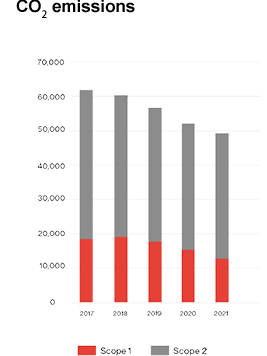
In 2024, we reduced our scope 1 and 2 emissions by 6.8 percent compared to 2023. The most significant proportion of our scope 1 and 2 emissions (66 percent) comes from our electricity consumption and district heating, while fuels and combustibles account for 34 percent. CO₂e emissions from fuels and combustibles fell by 8 percent in absolute terms, to 8,585 tons in 2024. CO₂e emissions from electricity and district heating fell by 6.3 percent, to 16,681 tons.
-
Emissions across our value chain
Most of Franke’s emissions are Scope 3 and generated through the use of our sold products. In 2024, this category amounted to 91.8 percent of our Scope 3 emissions. Other significant categories of emissions for Franke include those attributed to the purchase of goods and services, the capital goods needed for manufacturing our products, and the logistics associated with these. Many of the measures we have implemented in the past year to reduce our Scope 3 emissions are detailed within our sustainability report.
-
Progress tracking
One of our goals is to continuously improve measurements of the CO₂ emissions linked to our production, to the use of products we sell, to the goods and services we purchase, as well as transportation and distribution necessary to make it all happen. This data is key to determine and monitor emission reduction activities both upstream and downstream in our supply chain, ensuring our emissions reduction roadmaps are up-to-date and in line with our targets.
Green Living
Live a healthier life with products designed for the kitchens of the future.